


One day, Mirai was attending an in-house meeting. Then, I heard the word ‘photoliso’ several times from engineers.

What is a photoliso? Everyone is talking like it’s normal. Yes! Let’s tell MICRON!

Hey, hey, Micron, what kind of technology is the ‘photo liso’ you talked about at the meeting earlier?

Photoliso, that is, ‘photolithography’ technology. This is a transfer technique that uses light.
Hmmm… I don’t really know…

Well, I think so… For example, this technology is also used for making electronic circuits on glass substrates, so let’s take a closer look at the process!
① A film formation

First, attach the metal, which is the material of the electronic circuit, to the glass substrate. It is important to apply the thickness evenly at this time.
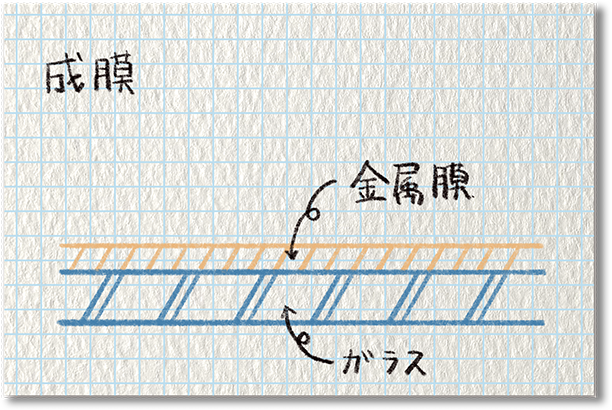
(*As for ‘film formation’ will be explained on another occasion.)
It seems difficult to apply metal evenly…
② Applying resist
Next, apply the resist. By the way, ‘Resist’ is one of the materials. There are those (positive type) that are easily melted in the areas exposed to light, and those that remain hardened (negative type).
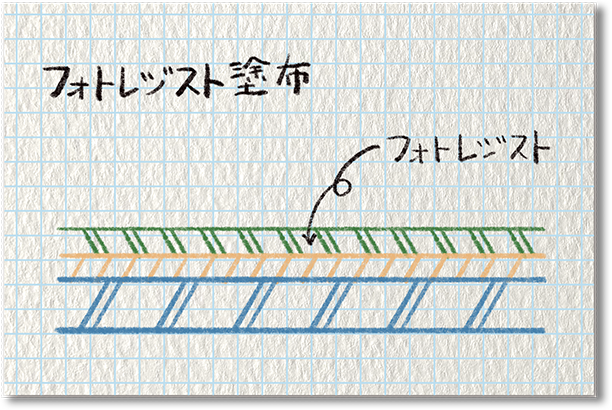
Wow, it’s a mysterious liquid that hardens or melts…
③ Making a mask
Next, we will design a circuit diagram (pattern) on a personal computer and create a ‘mask’ with a pattern drawn on materials such as glass. The mask has a part that allows light to pass and a part that does not pass, and the combination determines the shape of the circuit.

That mask acts like a ‘type’ of a circuit.
④ Exposure/development
Apply light to the substrate coated with the resist by layering the mask. Resist exposed to light chemically reacts, curing and dissolving more easily. To put it simply, it’s an image of changing the part of the sun like a sunburn.
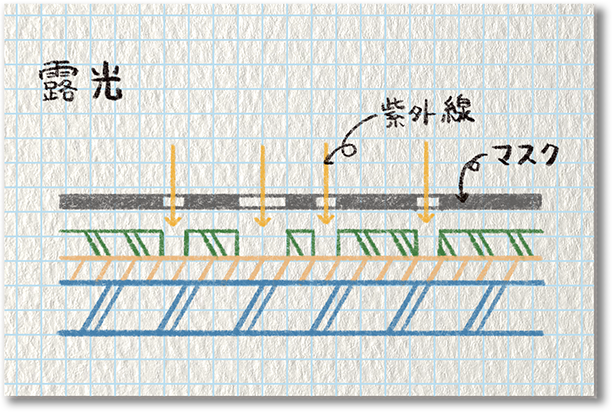
The resist reacts to the shape of the circuit pattern.
⑤ Etching
Soak the substrate in chemicals and remove unnecessary resist with chemicals.
After that, it is soaked in a chemical solution that dissolves the metal and only the metal in the part where there is no resist is dissolved.
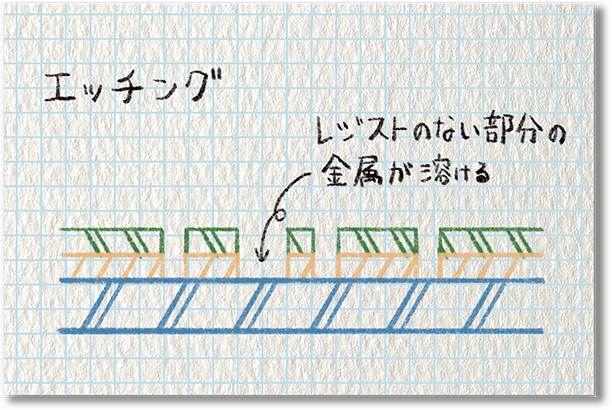
Indeed, there is a special medicinal solution that dissolves resist and a special chemical that dissolves metal.
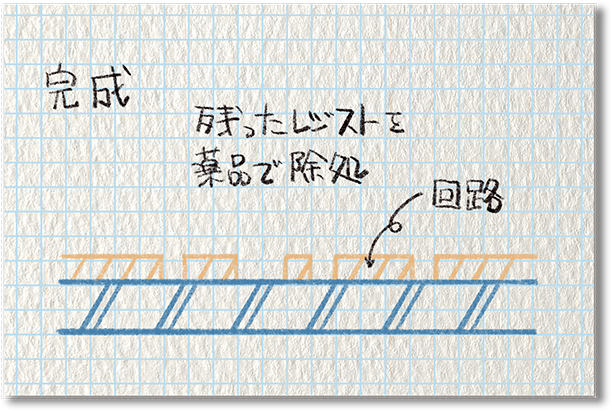
⑥ Finishing

After removing the remaining resists, the circuit is finished with a metal drawn on the glass substrate.
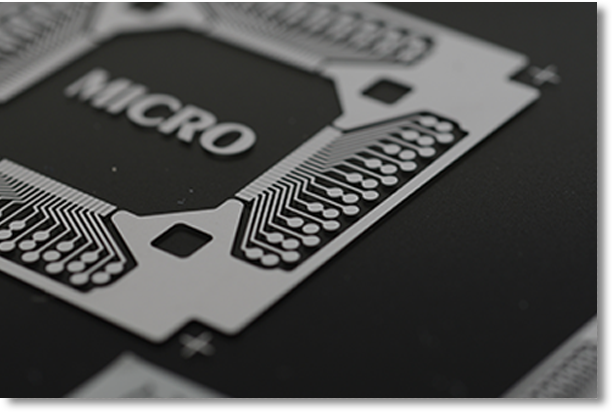
*Product enlarged photo

Amazing! ! A lot of processes can be done to create a circuit.
That’s right! A lot of know-how is needed because it’s a pattern made of thinner hair than hair. Each company has different areas of expertise.
That’s right! Well then, I wonder what Micro is good at, what’s different from others…?
Next time, what are the strengths of photo liso technology unique to the Institute of Microtechnology? MISAKI approaches the secret.